
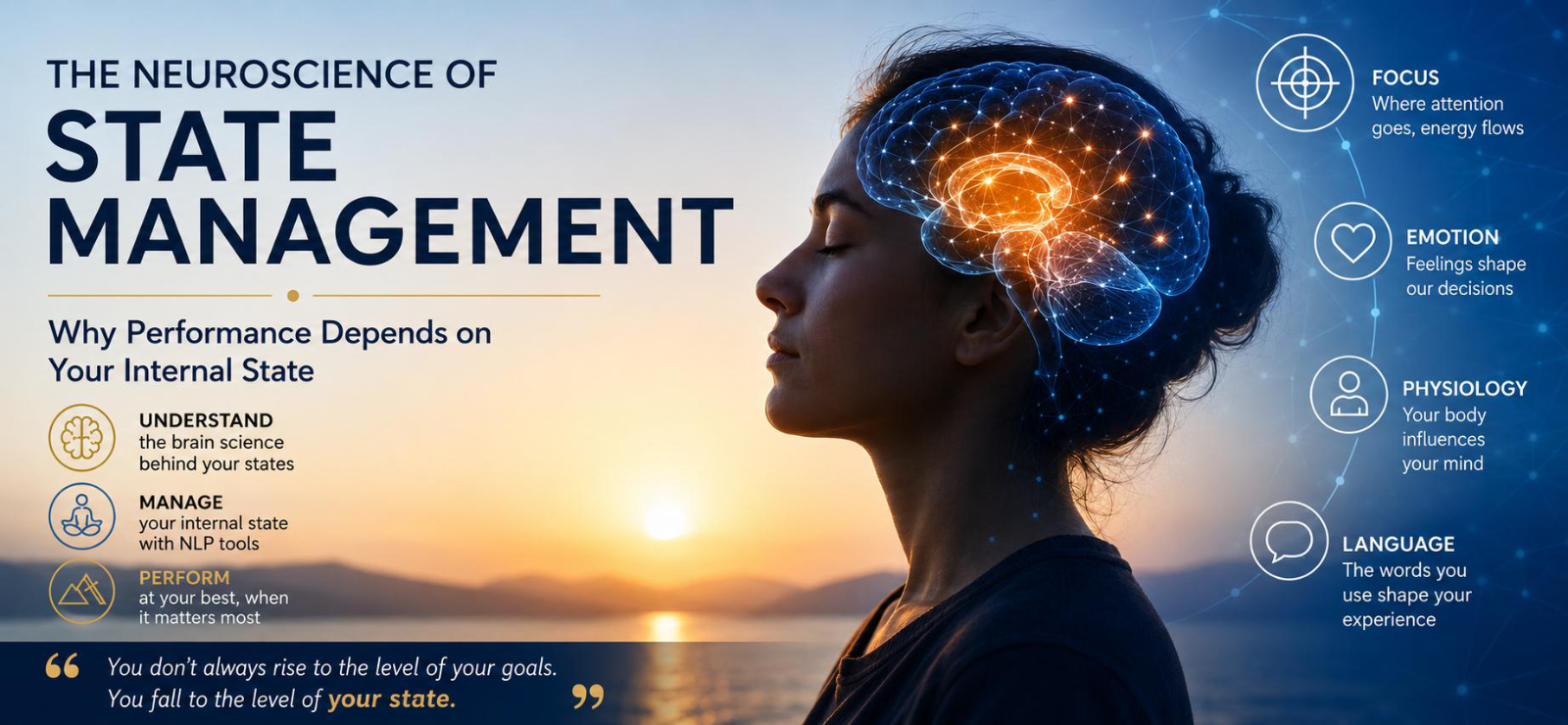
“People do not always perform according to their potential; they perform according to the state they are in when that potential is needed.”
When discussing performance, most people focus on skills, knowledge, experience, and strategy. These are undoubtedly important. However, there is another factor that often determines whether we perform at our best or fall short of our capabilities: our state.
In Neuro-Linguistic Programming (NLP), the concept of state has been central since the discipline’s inception. Whether in coaching, leadership, education, healthcare, sport, or personal development, the ability to manage one’s internal state can make the difference between success and struggle.
Today, advances in neuroscience are providing fascinating insights into why state management is so important and how NLP techniques can help individuals consistently access their best resources.
What Do We Mean by “State”?
A state is the combination of our thoughts, emotions, physiology, and focus of attention at any given moment.
Consider two scenarios. In the first, you are confident, focused, calm, and energised. In the second, you are anxious, distracted, and overwhelmed.
Your skills may be identical in both situations, yet your performance is likely to be dramatically different.
State influences:
- The decisions we make
- The quality of our communication
- Our ability to solve problems
- Our level of creativity
- How effectively we handle pressure
- The confidence we project to others
In essence, state determines how much of our potential we can access in a given moment.
The Brain Under Pressure
Neuroscience has shown that emotional states have a direct impact on brain function.
When we perceive a threat—whether real or imagined—the amygdala, often described as the brain’s alarm system, becomes highly active. This triggers the body’s stress response, releasing hormones such as cortisol and adrenaline.
While this response can be useful in genuine emergencies, it can become problematic in modern environments where perceived threats often involve presentations, difficult conversations, deadlines, or uncertainty.
Under prolonged stress:
- Attention narrows
- Creativity declines
- Memory retrieval becomes less efficient
- Decision-making quality decreases
- Emotional reactivity increases
At the same time, activity in the prefrontal cortex—the area associated with planning, reasoning, self-regulation, and executive functioning—can become impaired.
This means that when we need our highest-level thinking the most, stress can make it harder to access.
State and Performance
Research in psychology and neuroscience consistently demonstrates that peak performance occurs when individuals are in an optimal state of engagement.
Athletes often refer to this as being “in the zone.”
Musicians describe becoming fully immersed in performance.
Business leaders speak about periods of exceptional focus and clarity.
Although the contexts differ, the underlying principle remains the same: performance improves when physiology, attention, emotion, and cognition are aligned.
The challenge is not simply experiencing these states occasionally. The challenge is learning how to access them deliberately.
NLP and State Management
One of NLP’s enduring contributions is its practical focus on helping individuals change their state quickly and effectively.
Rather than analysing problems indefinitely, NLP often asks:
“What state would be more useful, and how can we access it?”
Several NLP approaches support this process.
Anchoring Resourceful States
Anchoring involves creating a reliable association between a stimulus and a desired emotional state.
Most people already experience unconscious anchors. A particular song may trigger nostalgia. A familiar scent may evoke powerful memories. A location may instantly influence mood.
NLP applies this principle intentionally.
By repeatedly linking a specific gesture, word, or physical action to a resourceful state such as confidence, calmness, or motivation, individuals can learn to access that state more readily when needed.
Managing Physiology
Our minds influence our bodies, but the reverse is equally true.
Changes in posture, breathing, movement, facial expression, and muscle tension all send information to the brain about our current condition.
A person standing tall, breathing deeply, and focusing outward is likely to experience a different emotional state than someone collapsed in posture and focused on internal worries.
This is one reason why many high performers use movement, breathing exercises, or mindfulness practices before important events.
Reframing Meaning
The meaning we assign to an experience influences our emotional response.
Two people can encounter the same challenge and interpret it very differently.
One may see a presentation as a threat to their reputation.
Another may view it as an opportunity to share valuable ideas.
The external situation remains unchanged, yet the internal state differs significantly.
Reframing helps individuals shift perspective and discover alternative meanings that support more effective responses.
Neuroplasticity: Why Practice Matters
Modern neuroscience has reinforced another important principle long recognised within NLP: repeated experiences shape the brain.
Neuroplasticity refers to the brain’s ability to form and strengthen neural pathways throughout life.
Every time we practise a new way of thinking, responding, or behaving, we strengthen associated neural networks.
This means state management is not simply about feeling better in the moment. It is also about developing new habits of attention, interpretation, and emotional regulation over time.
The more frequently we access resourceful states, the easier those states can become to access in the future.
Applications Across Different Fields
The principles of state management have broad applications.
Leadership
Leaders influence more than decisions; they influence emotional climate.
A leader who remains calm and focused during uncertainty often helps others do the same.
Coaching
Coaches frequently discover that clients already possess the resources they need. The challenge is helping them access those resources consistently.
Healthcare
Patients facing illness, rehabilitation, or chronic conditions often benefit from learning techniques that enhance resilience, self-efficacy, and emotional regulation.
Education
Students who can manage anxiety and maintain focus are often better able to demonstrate their knowledge and abilities.
Personal Development
Whether pursuing a career goal, improving relationships, or developing new habits, state management provides a foundation for sustainable growth.
The Future of Performance
As neuroscience continues to deepen our understanding of the brain, many of the practical insights that have informed NLP for decades are receiving increasing scientific attention.
While terminology may differ, the underlying message remains remarkably consistent:
How we think, feel, focus, and respond influences what we are capable of achieving.
Skills matter.
Knowledge matters.
Experience matters.
Yet the ability to access those resources at the right moment may matter just as much.
The question is not whether you have potential.
The question is whether you can consistently access it when it counts.
And that begins with managing your state.contextural logic, both as philosophy and practice, offers a powerful foundation for next-generation NLP—one that doesn’t just work on people, but works with the dynamic, layered logic of the human experience.
